Sustainability Strategy and Performance

An organization that facilitates sustainability

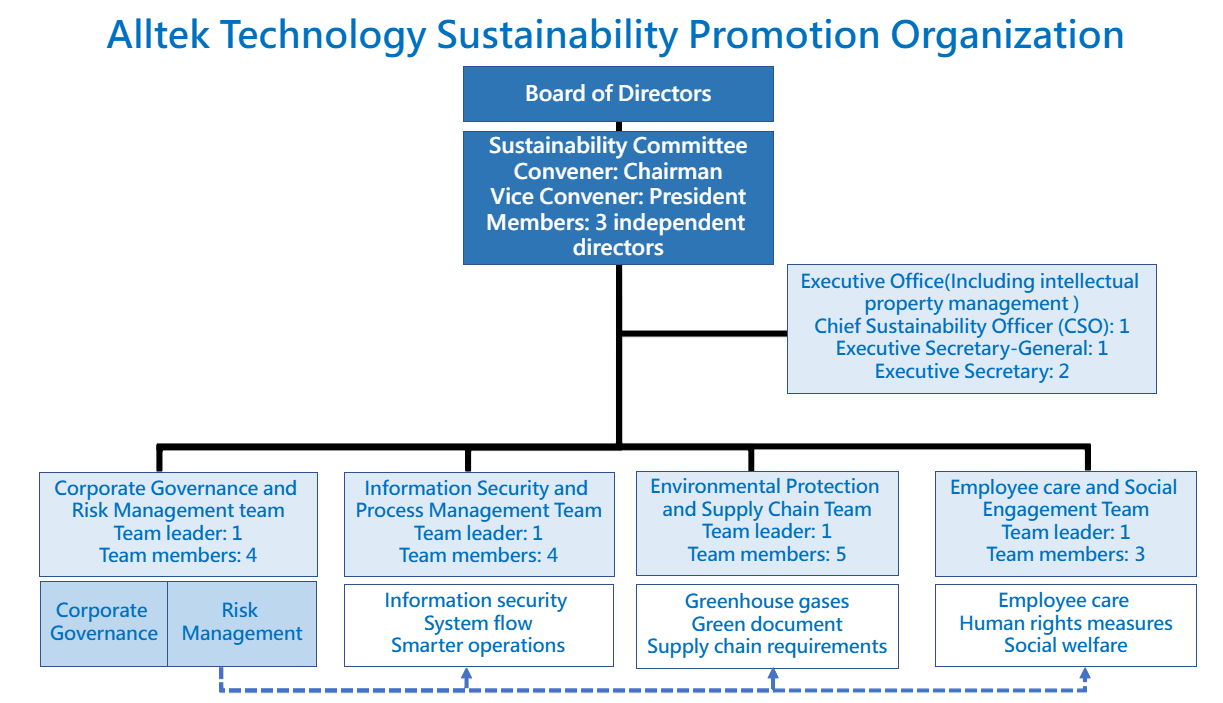
To implement the concept of sustainable management and fulfill corporate social responsibility, Alltek has established the “Sustainability Committee”.The committee consists of the company’s general manager and three independent directors to effectively promote the setting of the company’s sustainable goals. The committee includes sub-groups such as the Corporate Governance and Risk Management Subcommittee, Information Security and Process Management Subcommittee, Environmental Protection and Supply Chain Subcommittee, and Employee Care and Social Participation Subcommittee. These sub-groups are responsible for proposing, executing, and reporting on corporate sustainability-related matters. The chair of the Committee serves as the convener. Each team has a team leader who is responsible for the communication and coordination of matters under the control of the team, and compiles the information related to the team’s responsibility to facilitate various projects and respond to major issues of various functions.

Sustainability Performance in 2024

Aspect

Achievements in 2024

Corresponding SDG Indicator


Environmental aspect

  • Governance procedures related to climate change risks and opportunities, following the recommendations of the Task Force on Climate-Related Financial Disclosures (TCFD) issued by the Financial Stability Board (FSB). We disclose its performance for 2024 and its work goals for 2025 according to the framework recommended by TCFD.
  • Continuing the “Alltek Paper Reduction Campaign,” the paper usage in 2024 was 194,421 sheets, which is a reduction of 20,876 sheets compared to 2023. The reduced paper usage is equivalent to saving approximately 2.51 trees from being cut down.
  • In 2024, a total of 852 paper boxes were saved due to the implementation of combined box operations in the warehouse, resulting in savings of NT$99,345.
  • The warehouse environment has no packaging waste, and all received paper boxes and packaging materials are 100% recycled.
  • In 2024, 5,208 kilograms of paper boxes were recycled in the warehouse, which, after resource recovery, can reduce approximately 27,550 kilograms of CO2e carbon emissions.
  • The 2024 company-wide ecological education program will be conducted at the Longluan Lake Nature Center in Hengchun Township, Pingtung County, Taiwan. This will provide employees with an understanding of local biodiversity and habitats.

SDG 12 Responsible Consumption and Production

SDG 13 Climate Action

SDG 15 Conserve Terrestrial Ecosystems


Social aspect

  • Awarded the “Health Promotion Label” and “Sports Enterprise Certification” in 2024.
  • Professional occupational health nurses will conduct one-on-one health interviews and correct posture guidance from 2023 to 2024. The number of musculoskeletal survey abnormalities (suspected danger) showed a significant decrease of 2.2%.
  • There were no occupational accidents throughout the year.
  • Provide a diverse range of educational training courses, offering professional continuing education courses based on employees’ job needs. In 2024, employees received a total of 3343.75 hours of annual education and training.
  • Promote employee shareholding trust, and regular employees who have served in the company for more than 1 year can apply for membership.
  • In 2024, we participated in social inclusion initiatives across 3 key areas: social welfare (LED light bulb donations, sponsorship of the Mu Sheng Choir and the Chu Jong-Ching Performing Arts activities, and a performance by the “Believe Classic Orchestra,” a visually impaired group); technology talent cultivation (a research and development project in collaboration with National Formosa University); and healthy workplace initiatives (awarded the “Health Promotion Label” and “Sports Enterprise Certification”).


SDG 1 Ending Poverty

SDG 3 Health and Well-being

SDG 4 Education Quality

SDG 8 Jobs and Economic GrowthSDG 10 Reduced Inequalities

SDG 11 Sustainable Cities

SDG 17 Diversified Partnerships


Governance aspect

  • Won 17th TCSA Taiwan Corporate Sustainability Awards – Silver Prize for Corporate Sustainability Reporting.
  • No significant negative information.
  • No violations of economic regulations or fines.
  • 100% of the board members received anti-corruption education, training, and communication.
  • The attendance rate of the Remuneration Committee members was 100%.
  • In 2024, there were a total of 6 information security advocacy projects with 117 activities.
  • In 2024, there were no instances of sensitive information leakage or major information service interruptions that resulted in financial losses for customers or suppliers.
  • For the past 6 years, we have achieved zero errors in shipments through its warehouse management system. The on-time delivery rate, delivery accuracy rate, and inventory accuracy rate have all been 100%.
  • 100% of information technology vendors have signed the corporate social responsibility commitment.


SDG 8 Jobs and Economic Growth

SDG 9 Industry, Innovation, and Infrastructure

SDG 16 Peace and Justice Institutions

Risk management

Alltek has adopted a “Risk Management Policy and Procedures” method, approved by the board of directors in 2022, to ensure stable operation and sustainable development. This includes establishing a sound concept of integrity in operations and regularly assessing risks to reduce operational risks. The risk management policy defines various risks according to the Company’s overall operating guidelines, and establishes a risk management mechanism for early identification, accurate measurement, effective supervision, and strict control of risks to prevents possible losses within the tolerable risk range. The best risk management practices are continuously being adjusted and improved in accordance with changes in the internal and external environment in order to protect the interests of employees, shareholders, partners and customers, while also increasing the value of the Company, and achieving the principle of optimizing the allocation of company resources.

Risk Management Organization

The Company’s Board of Directors is the highest decision-making body for the Company’s risk management, with the objective of complying with laws and regulations and promoting and implementing the Company’s overall risk management. The Board of Directors has a clear understanding of the risks faced by the operations in order to ensure the effectiveness of risk management and assumes the ultimate responsibility for risk management. The board of directors has established a “Sustainability Committee,” which includes various functional teams responsible for analyzing and monitoring risks within their respective units. The Risk Management Team is responsible for implementing and promoting various risk management policies, holding meetings at least twice a year, and regularly reporting risk management results to the Sustainability Committee.

  • Internal audit

The internal audit of the company is an independent unit, staffed with one full-time auditor, directly reporting to the board of directors. They assist the board and management in supervising the various internal systems and processes, ensuring the effective implementation of the annual audit plan, and guaranteeing the effectiveness of internal audit procedures, the reliability of financial reporting, compliance with relevant laws and regulations, and providing timely improvement suggestions. This ensures the effective implementation of internal systems, solid supervisory mechanisms, and the execution of risk management controls.

螢幕擷取畫面-2025-08-18-111025
Summary of Internal Audit Progress in 2024

The internal audit procedures specify the internal control of internal audit and review of the operating procedures of the Company. The adequacy, effectiveness and efficiency of the design and routine operation of such controls are reported, covering the Company’s operations and its subsidiaries.
Audits are carried out in accordance with the audit plan approved by the Board of Directors. The audit plan is formulated based on the identified risks. Special audits or reviews are also carried out as needed. The comprehensive audit and special projects above provide information on the operation status of the internal control function of the management and provide management with another channel to understand the existing or potential defects in a timely manner.
Internal audit: Review the self-inspection performed by each unit, including checking whether the operation is implemented and reviewing the documents to ensure the quality of execution, and compile the results of the self-inspection and the results of each cycle of audit operations, and issues an annual “Statement of Internal Control System” report to the Board of Directors.

Risk management procedures

The risk management process is divided into four stages. Each risk management unit examines its own business and operational characteristics, identifies possible risk factors that the Company’s operations may face, develops a complete risk classification framework, and defines appropriate measurement methods as the basis for risk management.

  • Alltek reviewed its business and operational characteristics, and the risk categories and management measures for 2024 are as follows
Risk category Risk Management Measures for 2024
Operational risk

1. In accordance with regulations issued by the securities regulatory authority, we have established the Alltek Technology Sustainable Information Management Procedures and added “Sustainable Information Management” to our internal control system.

2. Conducted risk identification and risk assessment in each department to establish risk response and risk monitoring systems.

3. Implemented compliance with laws and regulations, and there were no illegal activities affecting operations in 2024.

4. The audit department formulated an annual audit plan based on risk assessment and executed it according to the plan.

Financial risk Enhance the management of major assets such as inventory and accounts receivable. Hold weekly meetings with department-level supervisors and monthly meetings with department-level managers to review operational status, assess risks, and develop response plans.
Information security risk Continuously implement information security protection measures in accordance with the “Cybersecurity Management Policy” and report the execution status to the board of directors in 2024.
Environmental risk Support the governance of climate-related risks and opportunities based on the framework proposed by the Task Force on Climate-Related Financial Disclosures (TCFD), published by the Financial Stability Board (FSB) in June 2017. Disclose annual performance and future goals according to their recommendations. To alleviate the potential financial risks posed by extreme weather events, businesses should proactively implement climate change risk management and mitigation measures to enhance their disaster resilience. For details, please refer to the section “6.1 Climate Risks” in this report.